
Mary Anning for kids
The Woman Who Found Dragons in Stone
- Say it
- MAIR-ee AN-ing
- Lived
- 1799–1847
Mary Anning was a fossil hunter who lived by the sea in England about 200 years ago. She found the bones of giant sea reptiles that lived long before people, and she helped scientists understand that the Earth is very, very old.
Growing up in Lyme Regis
Mary was born in 1799 in Lyme Regis, a small town on the south coast of England. Her family was poor. Her father, Richard, made furniture, and he also hunted the beach cliffs for fossils to sell to visitors. He took Mary and her brother Joseph along. When her father died in 1810, the family needed money badly, so Mary kept hunting. She carried a hammer and a basket and walked the beach after storms, when the cliffs crumbled and new fossils fell out.
A sea dragon in the cliff
Around 1811, Joseph found a strange, long skull. Over the next year, Mary dug out the rest of the skeleton. It was an ichthyosaur (IK-thee-oh-sore), a sea reptile shaped a bit like a dolphin. People had never seen anything like it, and some called it a sea dragon. Mary was only about 12 years old.
Bigger discoveries
In 1823, Mary found the first complete skeleton of a plesiosaur (PLEE-see-oh-sore), a sea reptile with a tiny head, a long neck, and four big flippers. It was so odd that one famous scientist first thought it was a fake. It wasn't. In 1828, she found a flying reptile called a pterosaur (TEHR-uh-sore). She also figured out that some smooth stones on the beach were really fossil poop, with tiny fish bones and scales inside.
A hard and brave life
Fossil hunting was dangerous. The cliffs could fall without warning. In 1833, a landslide nearly buried Mary, and it killed her dog, Tray, who went with her everywhere. Mary also faced unfair treatment. Women were not allowed to join the scientific clubs of her day, and scientists often wrote about her fossils without saying who found them. Still, the best scientists in Britain came to Lyme Regis to learn from her. Mary died in 1847.
Why Mary matters today
Mary's fossils are still in museums, including the Natural History Museum in London. Her discoveries helped people understand that many animals lived long ago and then died out, which was a big new idea at the time. In 2022, a statue of Mary with her hammer and her dog was put up in Lyme Regis, near the beach where she worked.
Questions to talk about
- Why do you think the best time to hunt fossils was after a storm?
- Mary wasn't allowed to join the science clubs. How do you think that felt?
- If you found a fossil, what would you want to know about it?
Common questions
Who was Mary Anning?
Mary Anning (1799–1847) was an English fossil hunter from Lyme Regis who found the first ichthyosaur skeleton recognized by scientists and the first complete plesiosaur.
Did Mary Anning find dinosaurs?
Not exactly. She found sea reptiles and a flying reptile that lived in the time of the dinosaurs. They are related to dinosaurs, but they are not dinosaurs.
What age is this book for?
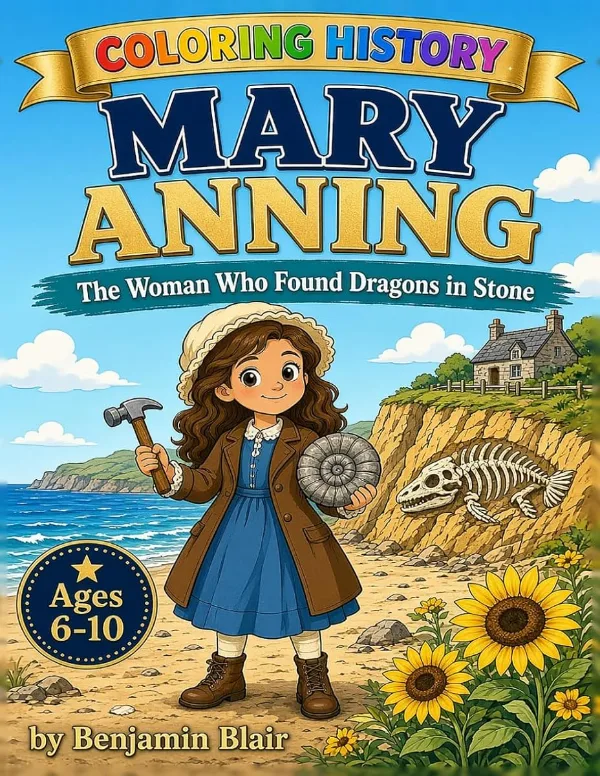
The Coloring History book about Mary Anning is written for kids ages 6–10, with short pages a first grader can read alone.
Color Mary's whole story
The Coloring History book about Mary Anning has 18 scenes to color, each with a short, easy page about what really happened. Ages 6–10, paperback.